Oncology: Ariana's analysis identifies predictive biomarker signatures for anti-MET therapy in solid tumors.
Overview
- This case study demonstrates how Ariana Pharmaceuticals’ KEM® Explainable AI technology uncovered a hidden responder signature during the early clinical development of ARGX-111, an anti-MET monoclonal antibody for solid tumors, enabling Argenx to make a pivotal strategic decision that ultimately led to the development of ARGX-113 (efgartigimod, Vyvgart®).
- Using multidimensional clinical and biomarker data from a Phase I dose-escalation study involving 17 patients, KEM® explored complex relationships between patient characteristics, cytokine profiles, pharmacokinetic data, and clinical outcomes. While the overall clinical activity of ARGX-111 appeared limited, Ariana’s analysis revealed a small but highly responsive patient subgroup and identified inflammatory biomarkers predictive of efficacy and adverse events.
- These insights improved understanding of the drug’s mechanism of action and informed Argenx’s strategic pivot toward developing ARGX-113, which subsequently became the blockbuster medicine Vyvgart®.
Impact:
- ● Identified a small but highly responsive patient subgroup at dose level #3 through biomarker-driven patient stratification.
- ● Revealed a pre-inflammatory cytokine profile strongly predictive of anti-tumor efficacy and adverse events.
- ● Improved mechanistic understanding of ARGX-111 by demonstrating limited cellular activity despite evidence of response in selected patients.
- ● Enabled Argenx to strategically redirect its antibody development program toward ARGX-113.
- ● Contributed to the early scientific foundation supporting the development of Vyvgart®, now approved globally for multiple autoimmune indications.
Objectives:
- ● Identify biomarkers associated with efficacy and safety in patients treated with ARGX-111.
- ● Discover patient selection biomarkers capable of identifying responders.
- ● Characterize cytokine signatures associated with therapeutic response and adverse events.
- ● Improve understanding of ARGX-111’s mechanism of action to support future drug development decisions.
Method and Study Design:
- ● Phase I dose-escalation study evaluating ARGX-111, an anti-MET monoclonal antibody for solid tumors.
- ● 17 patients included in the clinical analysis.
- ● Clinical variables included patient characteristics, cytokine measurements, dose information, pharmacokinetic (PK) data, and safety observations.
- ● Analysis incorporated 165 variables together with preclinical data from 40 animal studies.
- ● 12 predefined efficacy endpoints assessed across treatment groups.
Exp-AI analysis:
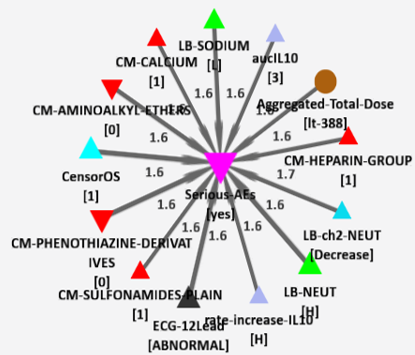
- ● KEM® Explainable AI explored 2,719 logical relationships between biomarkers, clinical variables, efficacy, and safety outcomes.
- ● Association-rule mining identified biomarker combinations predictive of treatment response and toxicity.
- ● Explainable analysis enabled identification of responder signatures and mechanistic relationships between cytokines and clinical outcomes.
- ● Results were presented as transparent, interpretable biomarker networks to support scientific and clinical decision-making.
Results:
- ● Ariana’s KEM® platform identified a small but highly responsive patient subgroup at dose level #3.
- ●The analysis demonstrated that ARGX-111 produced limited cellular activity (lymphocytes/monocytes), helping explain the modest overall clinical efficacy observed during the study.
- ● A pre-inflammatory cytokine profile was identified as highly predictive of anti-tumor efficacy and adverse events, providing valuable insight into patient response.
- ● The biomarker findings significantly improved understanding of the biological mechanisms underlying treatment response and safety.
- ● These insights enabled Argenx to optimize the design of its next-generation antibody program (ARGX-113), leading to a strategic pivot in its clinical pipeline.
Business Outcome:
- ● Ariana’s analysis informed the scientific understanding that supported Argenx’s decision to prioritize ARGX-113 over continued development of ARGX-111.
- ●ARGX-113 (efgartigimod) was subsequently developed into Vyvgart®, now approved in multiple autoimmune diseases, including generalized myasthenia gravis (gMG), chronic inflammatory demyelinating polyneuropathy (CIDP), and immune thrombocytopenia (ITP).
- ● Vyvgart® has become Argenx’s flagship product and a multi-billion-dollar commercial success, validating the strategic direction established during the early biomarker analyses.